 Ancient3DCrafts
Hero · A3D-116 and A3D-076
Trajan
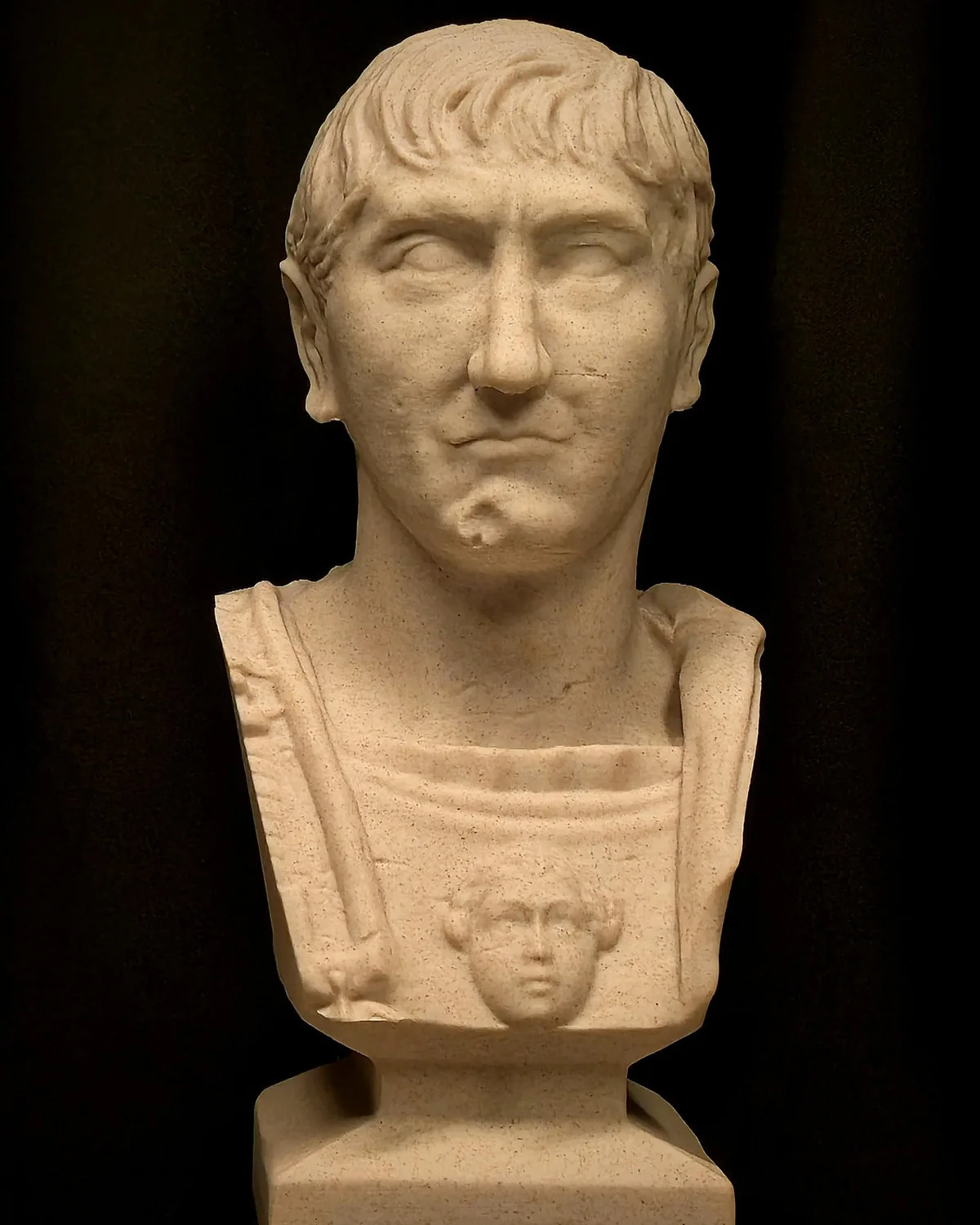
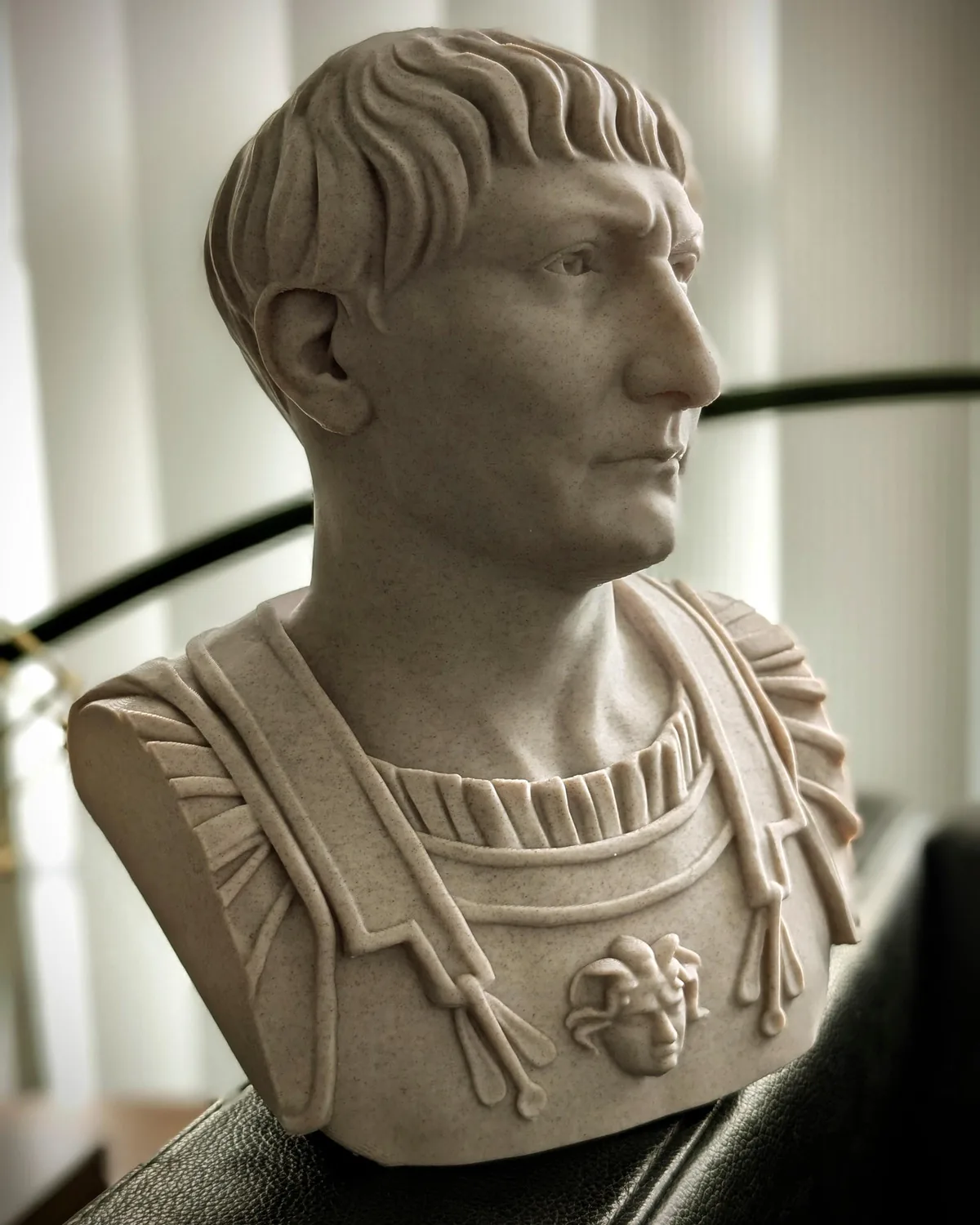
Trajan is one of the three stocked heroes in this gallery, with Hadrian and Marcus Aurelius. Ancient3DCrafts makes two distinct marble-composite portraits of him: a 600 g SPQR-style bust (SKU A3D-116) and a heavier 920 g “high quality” type (SKU A3D-076). Both are modern replicas, made by Shane in Richmond Hill, Ontario, and sold on Etsy only. They are not ancient marble, and they are not the portraits on the Column or in the Vatican. The photographs here are the shop’s own, cropped tightly to the sculpture.
Open TODOs before launch — these were not confirmed from a live Etsy fetch and are not guessed here.
- The listing body contains the typo “fees like poured.”
Who Trajan was
Marcus Ulpius Traianus was Roman emperor from 98 until his death in 117. He was born in Italica, in Hispania, and adopted by Nerva. Later tradition, condensed in the epitome of Cassius Dio and in the way the Senate greeted later emperors, treated him as the yardstick: felicior Augusto, melior Traiano — more fortunate than Augustus, better than Trajan. That is praise, not a measured biography, and this page does not turn it into one. What can be said more quietly is that his wars in Dacia, recorded on the spiral relief of his Column in the Forum that still bears his name, and his building in Rome, are the public facts behind the face.
The official portrait type is a middle-aged man, hair combed forward in comma-shaped locks, a strong neck, no beard — the last of the clean-shaven imperial faces before Hadrian made the beard fashionable. Shane’s two busts follow that general official look. We do not claim a particular museum inventory as the exact source of either listing, because the shop texts do not establish one that we could verify. If that changes, the editorial policy is to correct the page, not to leave a flattering guess in place.
The two busts in the shop
The lighter bust, A3D-116, is US$69.99–US$103.99 (from–to by size), weight 600 g. The Etsy listing URL is confirmed: listing 4489150511. The heavier bust, A3D-076, is US$99.99–US$155.99, weight 920 g. Its Etsy listing is 4451592571. One listing text for the heavier type contains a typo, “fees like poured,” which we flag rather than silently correct in a way that would pretend the source was clean.
Price: US$69.99–US$103.99 (from–to by size variant), in US dollars as listed on Etsy.
Price: US$99.99–US$155.99 (from–to by size variant), in US dollars as listed on Etsy.
Processing time for both is 3–5 business days. Sizes, as with the rest of the marble-composite line, vary by variant; check the live listing when it can be confirmed. Shipping and returns are the Etsy shop’s: exchanges only within seven days, no refunds, the buyer pays return shipping, cancel within twelve hours. US import duties are collected in Etsy checkout for US orders. Payment is on Etsy only — there is no cart on this site.
How Trajan sits in the pack
On the heroes page Trajan is the soldier-emperor of the Column and the Forum. He is not, on this site, lumped in with Nerva or Antoninus Pius, who are not in the shop. He is also not the same product as the supporting founder portraits of Julius Caesar and Augustus, or as Lucius Verus. A customer named Mackenzie wrote, word for word, after buying Augustus, that he had told Shane he wanted a statue of Trajan and that “It is very good.” That is a review of the work, not a museum comparison. If you are choosing between the 600 g and 920 g types, the weights, the USD ranges and both Etsy URLs are on this page. Processing time is 3–5 business days for either.
Questions: contact or ancient3dcrafts@gmail.com. Who Shane is: the about page. What the composite is: materials. Common questions: the FAQ. The darker shelf of the same pack is on the villains — Nero and Caligula — and is sold under the same rules, from the same workshop. Photograph reuse is explained on the image licence page. Privacy is on the privacy notice.
Back to the home page of this gallery, or to the heroes and villains essays.